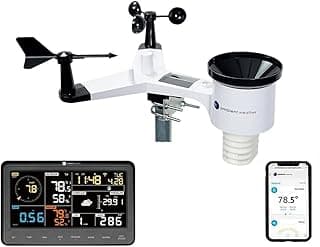
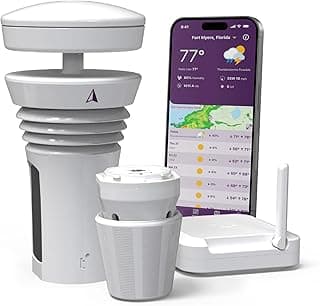
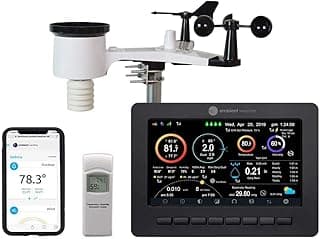
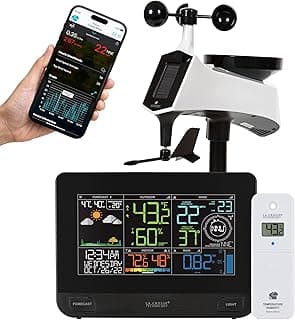
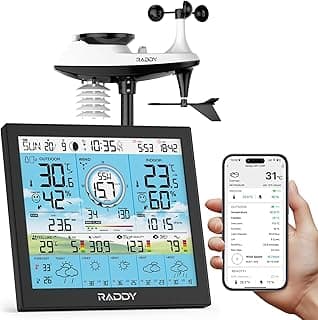
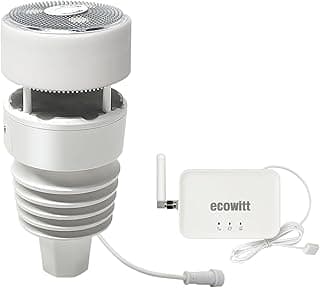
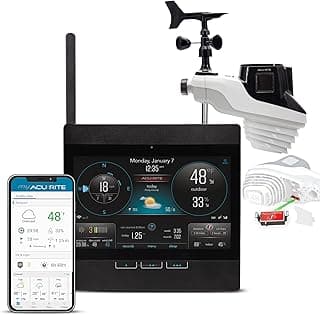
Buying Guide: Best Weather Station with App
Choosing a weather station with app support can feel overwhelming when you're trying to track local conditions more accurately than a basic phone app, especially if you're unsure about setup or long-term reliability. This guide breaks down the key factors to consider, helping you focus on what matters for your specific needs like home monitoring or gardening.
Sensor Accuracy and Range
Sensor accuracy determines how reliable your hyper-local weather data is, which is crucial for decisions like protecting plants from frost or planning outdoor activities. Inaccurate readings can lead to misguided choices, so prioritize stations with calibrated sensors for temperature, humidity, wind, and rain.
- Look for models offering ±1°F temperature accuracy and ±3% humidity precision in most conditions.
- If you need coverage over a larger yard, opt for wireless sensors with a range of at least 300 feet.
- Avoid units with unproven sensors if precise data is key to your use case.
App Features and Connectivity
The app is the heart of a weather station with app integration, turning raw data into actionable insights like forecasts, alerts, and historical graphs. A clunky app can make the device frustrating, while a smooth one enhances usability for daily checks or sharing data.
- Choose apps with real-time notifications, customizable dashboards, and data export options for most users.
- If you share data with family, ensure multi-device support and cloud syncing.
- Stick to Wi-Fi or cellular connectivity over Bluetooth alone if you want remote access from anywhere.
Power Source and Battery Life
Reliable power keeps your station running through outages or remote placements, preventing data gaps during storms. Solar-powered options reduce maintenance, but battery backups are essential for consistent performance.
- For outdoor setups, select models with solar panels and rechargeable batteries lasting 1-2 years.
- If mains power is available, wired options work well but add installation steps.
- Avoid fully battery-dependent units in cold climates, where battery life drops significantly.
Installation and Durability
Easy installation means you can set up quickly without tools or climbing ladders, while durability ensures it withstands rain, wind, and temperature swings. Many users worry about complexity, but most modern stations are designed for straightforward mounting.
- Go for pole or wall-mount kits with included hardware if you're not handy.
- Choose weatherproof ratings like IPX5 or higher for exposure to elements.
- If placing in harsh conditions, prioritize UV-resistant plastics and metal components over basic plastics.
Data Logging and Alerts
Built-in logging stores trends over time, helping you spot patterns like seasonal humidity shifts, while alerts notify you of extremes like high winds. This is particularly useful for homeowners in variable climates.
- Seek at least 12 months of cloud storage for historical data.
- If sudden changes matter, like for boating or farming, enable customizable thresholds for rain or temperature.
- Skip basic models without alerts if proactive monitoring is your goal.
Cost vs. Value Over Time
Upfront cost is tempting to minimize, but factor in expansion options and app subscriptions for long-term value. Affordable stations often suffice for casual use, while feature-rich ones pay off for frequent reliance.
- For basic backyard tracking, aim for options under $150 with core sensors.
- If expanding with extras like soil moisture probes, budget $200-400.
- Watch for hidden fees like premium app features, and calculate based on your expected usage duration.
Frequently Asked Questions About the Best Weather Station with App
What is the best weather station with app for home use?
The best weather station with app combines accurate sensors for temperature, humidity, wind, and rain with a user-friendly mobile interface for real-time monitoring. Look for models with reliable connectivity like Wi-Fi or Bluetooth to ensure seamless data syncing without constant manual checks. In most cases, top options provide customizable alerts and historical charts, making them ideal for homeowners tracking local microclimates.
How much does a good weather station with app cost?
A quality weather station with app typically ranges from $150 to $400, depending on the number of sensors and advanced features like solar power or lightning detection. Entry-level models around $150 offer basic indoor-outdoor tracking, while premium ones near $400 include professional-grade accuracy for enthusiasts. Factor in long-term value: durable builds reduce replacement costs over time.
Is a weather station with app safe to install outdoors?
Most weather stations with apps are designed with weatherproof housings rated IPX5 or higher, protecting against rain, wind, and temperature extremes if properly mounted. Safety concerns are minimal when you secure the unit 5-10 feet off the ground away from power lines and use included mounting hardware. Always check for overvoltage protection in the base station to safeguard indoor electronics during storms.
How easy is installation for a weather station with app?
Installation usually takes 20-45 minutes with basic tools like a drill and screwdriver; most kits include pole mounts and clear app-guided instructions. Position the outdoor sensor array in an open area for accurate readings, then connect via the app for automatic setup. If you're not handy, opt for models with magnetic or strap mounts to simplify the process without permanent fixtures.
How does a weather station with app compare to smart home devices?
Unlike basic smart thermostats or indoor sensors, a full weather station with app delivers comprehensive outdoor data like barometric pressure and UV index that generic devices can't match. It's more efficient for precise local forecasting, reducing reliance on public apps that average data over wide areas. For efficiency, choose one with low-power modes and app integrations to complement your existing smart ecosystem without overlap.
Conclusion
Choosing the best weather station with app comes down to reliable sensors, intuitive app integration, and real-time data accuracy for your needs. We've covered the essential features that ensure seamless monitoring of temperature, humidity, wind, and more, right from your phone.
With the right model, you'll gain confidence in tracking local conditions effortlessly. Take a moment to match these priorities to your setup, and select the one that fits best to elevate your weather insights today.